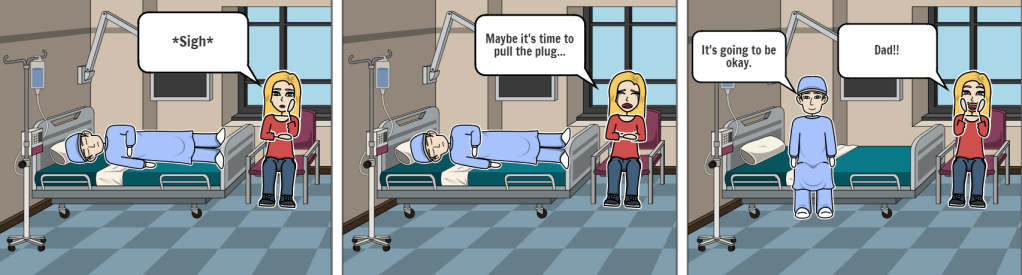
In this comic strip, the daughter is sighing in the first panel, knowing she has to make a choice. In the second panel, she says that it might be time to pull the plug on her father’s life support, allowing him to die. In the third panel, he wakes up and tells her it is going to be okay, and she is ecstatic to see him.
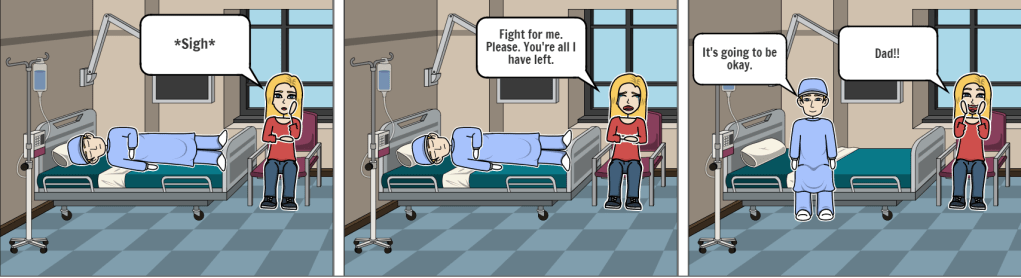
In this comic strip, the daughter sighs, and we find out in the next panel that it is because she needs her dad to survive. In the last panel, he wakes up, and she is super happy because now she has her dad again.
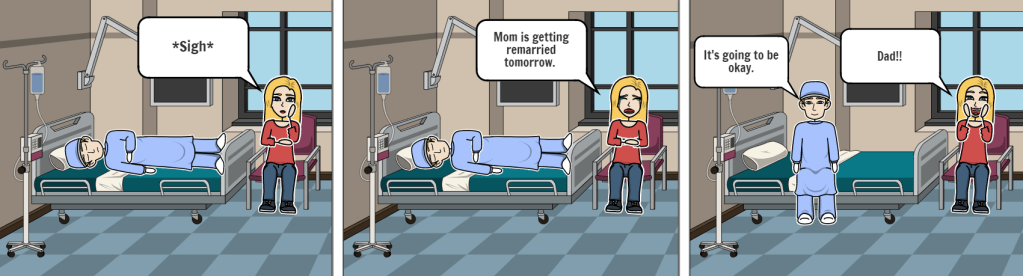
In this comic strip, the daughter is sad because her mother is about to be remarried, due to her father being in a coma. Once he hears this, he wakes up to get his wife back.
Closure in the comic world is when you see parts of something, but actually comprehend everything in the scene, even though you didn’t actually see it. What I learned from this is that the middle panel had a big effect on not only the meaning of the last panel, but also the first. It showed me why the actions of the first panel happened. In the first comic, it was because she was about to make a tough decision. In the second, it was because she was basically heartbroken. In the last, it was because she had to deliver tough news to someone who she thought wouldn’t be able to fix it. The effects the second panels had on the final panel in each comic strip also differed. In the first, she was very happy because she was about to let him die, and he was saved. In the second, it was because she really needed him in that moment, and he was surprisingly able to be there for her. In the last, it was because he was able to wake up and have the option to save his marriage.
Another thing that is important in closure is the gutter between comic panels. This is when the reader decides what happens between panels. Every reader’s mind is there own, and everyone sees the gutter differently. This is why comics are important. I really enjoyed learning about this and creating my comic strips!
Four Species of Antarctic Penguins
There are 17-19 species of penguins in the world. The reason I give a range of numbers is that the number of species is still up for debate. But today we are going to focus on the four types of Antarctic penguins. This is not including species on Sub-Antarctic islands. They are Adélie, Chinstrap, Emperor, and Gentoo. They have many similarities and differences, including based on size and population. Two of the species live exclusively in Antarctica, and two live in other places as well as Antarctica. Currently, there are about 12 million total penguins there. (USA Today).
The first type of penguin I will discuss is the Adélie penguin. “Scientists now believe more than 4.5 million breeding pairs of Adélie penguin population exist in Antarctica today, about 1.5 million more than they estimated 20 years ago,” (Smithsonian Magazine). Out of the four species, this one has the largest population. As well as living in the country of Antarctica, it lives on coastal islands surrounding that area. “Male and female Adélies are a very similar size and have very similar features, which makes it hard to tell the difference between them. They sport a characteristic ‘tuxedo’ look, with a black back and head, white chest and belly, and white rings around the eyes,” (World Wildlife Fund). Adélies eat krill (which is similar to shrimp), fish, and squid. Seems like even penguins enjoy calamari! Adélies mate for life and build their nests from rocks, eventually laying two eggs a few days apart. The males attract females by making the biggest nests. Adélie chicks leave their home between 7-9 weeks, and come back to breed about 3-5 years later. “The Adélie penguin got its name from the French Antarctic explorer, Jules Dumont d’Urville. On discovering these sea birds in 1840 he decided to name them after his beloved wife – Adéle,” (World Wildlife Fund). They are known to be small, actually the littlest of these four species, but still feisty, even taking on seals. They walk, or waddle, on land at about 1.5 miles per hour, and swim at about 2.5-5 miles per hour. Some Adélies can get up to over 9 mph. “Adélies can hold their breath for up to six minutes and frequently reach 150m,” (WWF). They are about 70 centimeters tall. Another interesting fact is that Adélies sometimes breed with Gentoo penguins, another species I will talk about later on.
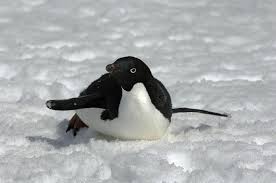
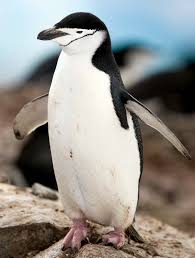
The next penguin species is the Chinstrap penguin. Chinstraps get their name from the black stripe seen on their chin. “Appearance: Black back, flippers, and cap on head. Black bill and black ‘strap’ running under chin,” (Oceanwide Expeditions). Including both the Sub-Antarctic region and the actual continent of Antarctica, it is estimated that 12 to 13 million Chinstraps currently exist on Earth. This involves an estimated 8 million pairs living on the Antarctic Peninsula. Their average lifespan in the wild is 15 to 20 years. They stand at around 71 centimeters and weigh 9-14 pounds, (Wild Republic). They dive around 70 meters, and swim at 20 miles per hour. Chinstraps are one of the penguin species that molt their feathers. In regards to food, “Chinstrap penguins are carnivorous birds and catch numerous species of fish, crabs, shrimp, squid, and krill with their strong beaks. Parents hunt for food in the ocean to take back to their chicks on the land,” (Wild Republic). Chinstraps migrate north for the winter, toward the sea. They are sometimes referred to as “Stonebreaker Penguins,” due to their piercing shriek that can fragment stones. They are close with Gentoo penguins and are one of the most aggressive species of penguin. When they get in fights, they may point, stare, or charge.
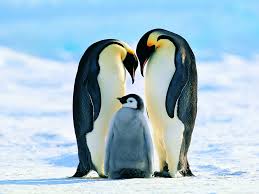
The Emperor penguin is a type of penguin that has an interesting appearance. On the outside of different parts of their bodies, they tend to be black, but the insides of some appendages tend to be yellow or orange. “The emperor penguin has orange or yellow areas on both sides of the head that become lighter as they go down to the chest area. The rest of its head and face are completely black, and its beak is black, long and curved downward with a soft pink or orange color stripe on each side. The outer face of its flippers is black, but the inside is white. Its legs are thick, dark, robust and equipped with large claws. The back is black, and the front is white from the legs to the belly blending into a light yellow when reaching the upper part of the chest,” (Penguins-World). They also have a rough, spiky tongue. The Emperor population is much lower than that of the other three penguin species. “Roughly 130,000 to 250,000 breeding pairs of emperor penguins live in 54 colonies worldwide,” (New York Times). Emperors eat mostly fish and krill, but will also eat squid and crustaceans. They swim at 7.6 miles per hour, can hold their breath for 20 minutes, and can dive up to 565 meters- more than any other bird. They are also the biggest penguin species, at four feet tall and just under 100 pounds. Emperors huddle together in the cold, wander around, sing songs, and even almost dance when courting each other, (Antarctica.gov). The males are the ones who incubate the eggs, while the females go back out to sea.
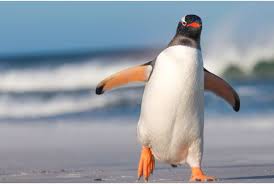
The final type of Antarctic penguin is the Gentoo penguin. This species has a total population in multiple countries of about 387,000 breeding pairs. Of the sub-Antarctic islands, the Gentoo penguin is the kind with the lowest population. Actually, their population is decreasing. Gentoos have a wide white stripe stretching across the top of their heads and a bright orange-red bill. It has light pink webbed feet and a long tail, the longest of all species. They are 30 inches tall and weigh approximately 12 pounds, making them the third-largest penguin species. They tend to eat crustaceans, squid, or small fish. Gentoo penguins can swim 22 miles per hour, but normally swim 4-7, (Smithsonian Magazine). They can also dive about 200 meters and hold their breath for seven minutes. When Gentoos mate, they tend to mate with the same partner as before about 90% of the time, but sometimes they can end up having two or three different mates in their lifetime. They lay two eggs per breeding season, three days apart from each other. “Both parents take turns incubating the eggs over the following 34–37 days,” (Britannica).
In conclusion, each type of Antarctic penguin is unique, even though they also have their similarities. With the Adélie penguin, I liked learning about when they leave as a chick, and when they come back to the island as an adult to mate. I learned about the Chinstrap penguin’s screeching noise, which I had never heard of. The Emperor penguin is big enough for me to give it a hug, and I definitely would if given the chance. Lastly, I want to adopt a Gentoo penguin because their population is decreasing, and they are beginning to get on the endangered list, which is very unfortunate.


Works Cited
Trevino, Julissa. “Scientists Discover ‘Super-Colony’ of 1.5 Million Adélie Penguins in Images From Space.” Smithsonian Magazine, 2 Mar. 2018, http://www.smithsonianmag.com/smart-news/adelie-penguin-super-colony-found-after-scientists-look-space-images-180968326/.
“10 Facts about Adélie Penguins.” WWF, http://www.wwf.org.uk/learn/fascinating-facts/adelie-penguins.
Rice, Doyle. “There Are 12 Million Penguins in Antarctica. This Researcher Says That’s Not Nearly Enough.” USA Today, Gannett Satellite Information Network, 25 Apr. 2017, http://www.usatoday.com/story/tech/sciencefair/2017/04/25/brrrd-count-penguin-population-antarctica-12-million-report-says/100839574/.
“Chinstrap Penguin.” Wild Republic, http://www.wildrepublic.com/product/chinstrap-penguin/.
“Chinstrap Penguin.” Oceanwide Expeditions, oceanwide-expeditions.com/to-do/wildlife/chinstrap-penguin.
Penguins-World. “Emperor Penguin.” Penguin Facts and Information, 2017, http://www.penguins-world.com/emperor-penguin/.
Weintraub, Karen. “An Emperor Penguin Colony in Antarctica Vanishes.” The New York Times, The New York Times, 25 Apr. 2019, http://www.nytimes.com/2019/04/25/science/emperor-penguins-antarctica.html.
“Emperor Penguin Breeding Cycle.” Australian Government, Department of Agriculture, Water and Environment, Australian Antarctic Division, 16 May 2008, http://www.antarctica.gov.au/about-antarctica/wildlife/animals/penguins/emperor-penguins/breeding-cycle.
Rafferty, John P. “Gentoo Penguin.” Encyclopædia Britannica, Encyclopædia Britannica, Inc., 18 Dec. 2017, http://www.britannica.com/animal/gentoo-penguin.
 Ali's World Lit Honors Blog
Graded on:
Length
Sophistication
Care/Appearance
Grammar
“Voice”
Credibility of Research
Proper Citations
Needs improvement on:
Grammar (one run-on)
“Voice”
LikeLike